
After reviewing over 1000 MRIs from persons with AA, we have come to the conclusion that at least ½ of the persons with AA have had some “seepage” or “leakage” of spinal fluid through the arachnoid-dural spinal canal covering into the tissues between the spine (bone) and the skin. This discovery has been made possible because the dye used in contrast MRI’s can be seen outside the spinal canal if there is “seepage”. Usually the “seepage” is slow (“drip at a time”) in contrast to a “leak” (“a steady stream”). One can have sort of a cross between a leak and a seep. Spinal fluid is not meant to leave the spinal canal as it is toxic to the muscles, nerves, tendons, and connective tissue in the lower back.
The cause of seepage is inflammation. AA is an inflammatory mass that may grow and erode through the arachnoid-dural spinal canal covering and allow spinal fluid to seep into the non-spine tissues. The good news is that seepage can usually be stopped with the anti-inflammatory agents that are recommended for AA treatment: methylprednisolone, curcumin/turmeric, pregnenolone, ketorolac, dexamethasone, naltrexone, DHEA, diclofenac.
Why AA Causes Spinal Fluid Leaks
Gross Misunderstanding: Adhesions are fibrous bands or structures which abnormally adhere body tissues to one another. AA of the lumbar-sacral spinal canal is a disease in which adhesions abnormally glue cauda equina nerve roots to the arachnoid-dura covering of the spinal canal. Although AA is named for the inner layer (arachnoid) of the spinal canal cover, its adhesive mass may also involve the outer layer, the dura. Adhesions and inflammation damage the arachnoid-dural covering and makes it porous and permeable so that spinal fluid can leak out and, conversely, any fluid in the epidural space can enter the spinal canal.
MRI Confirmation: If AA involves the dural layer, spinal fluid leakage, if significant, can be seen on the new contrast MRI. Old leakage trapped in tissues outside the spinal canal can often be seen.

AA Leakage Diagram of Spinal Canal
The AA mass may enlarge thru the dura and even into the epidural space. Leaks may occur at this point.
NOTE: The actual size of the spinal canal is about the size of one’s index finger.
THE “EMPTY SAC” SIGN – WHAT DOES IT MEAN?
Physicians have referred to the lumbar-sacral spinal canal as the “thecal sac” since it only contains nerve roots and no spinal cord.
Its presence is a call for immediate, aggressive action by the person who has the sign.

CAUSE OF THE SIGN: Inflammation and adhesions have glued, many, if not all the cauda equina nerve roots, to the inside wall of the spinal canal covering. The spinal canal covering becomes inflamed, loses its tensile strength, and becomes flabby, soft, and dilated. Spinal fluid pools at the bottom portion of the spinal canal.
CONSEQUENCES AND SYMPTOMS:
- Seepage of spinal fluid through canal cover
- Pooling and stasis of spinal fluid resulting in eye, ear, and nose symptoms since fluid flow is impeded
- Dizziness, poor balance
- Pain when sitting
- Urinary, intestine, and sexual dysfunction
- Progressive severe pain
EYE, EAR, AND NASAL SYMPTOMS: Too many persons afflicted with AA and their medical practitioners believe eye, ear, and nasal symptoms are caused by spinal fluid leaks, because they are not aware that symptoms can be caused by spinal fluid flow obstruction. A true leak requires MRI confirmation. Eye, hearing, and nasal symptoms with AA are common. They include blurred vision (spots), ear ringing (tinnitus), funny smells, nasal watering, and headaches or pressure sensations.

TREATMENT:
Aggressive 3-component treatment protocol
- Suppress inflammation
- Promote tissue regeneration
- Pain relief
COMPLICATIONS: Spinal fluid is an acidic irritant to ligaments, muscles, and fascia which are outside the spinal canal. The body attempts to push leaked spinal fluid to the skin so it can evaporate into the air. Spinal fluid that leaks into muscles and other tissues causes inflammation and severe pain. Chronic leakage can cause muscles and tendons to scar and contract. In this case a person with AA may find that they can’t fully extend their arms or legs or stand up straight.
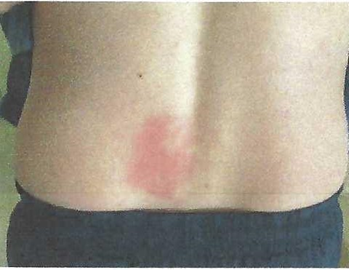
TREATMENT: Small leaks in the spinal canal covering seem to heal with about any of the agents that suppress intraspinal inflammation. The list of agents includes corticosteroids, Toradol®, turmeric, and diclofenac. Electromagnetic therapies (e.g., Provant®, PEMF, laser) seem very effective. Large leaks (see images below) usually require aggressive treatment. We start with a 6-day Medrol® Dose Pak and continue treatment with tissue restoration hormones such as HCG, nandrolone, DHEA, or testosterone. Leakage represents a severe case of AA and requires an on-going program of suppression of spinal canal inflammation and tissue restoration.
TREATMENT SUMMARY: Fortunately, the dural layer of the spinal canal covering appears to heal with inflammation suppression and tissue restoration measures. AA, particularly if it causes leaks, is a serious, often catastrophic disease. We continue to advocate an on-going 3-component medical protocol: (1) inflammation suppression, (2) tissue restoration, (3) pain control. Specific dietary and physical measures as described in other bulletins are also deemed essential to stop and prevent spinal fluid leaks.

HUGE SPINAL FLUID LEAK CAN PRESENT WITH SKIN INDENTATIONS
The person pictured here presented herself to multiple medical professionals who informed her that the red streaks and indentations on her back couldn’t possibly be related to adhesive arachnoiditis (AA). Her MRI showed the massive spinal fluid leak pictures here.

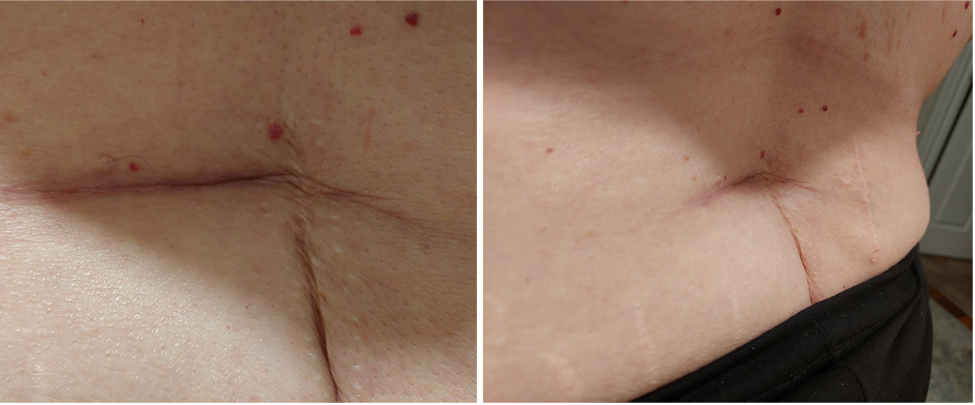
EXPLANATION: Spinal fluid is a toxin and irritant to tissues outside the spinal canal. Leakage or seepage due to AA may soak muscles and other tissues between the spinal canal and the skin. This may lead to contracture of muscles and skin, and one result may be the inability to fully extend legs and arms. Severe leaks require nutritional, hormonal, and electromagnetic measures to heal the spinal canal covering (meninges).
SUMMARY: Indentation of the back and contractures of the lower back muscles and skin may be caused by AA and require aggressive treatment.